
Behavioral Architecture
Seven layers that identify the behavior, capabilities, tools, conditions, and barriers the program must address.
Audacious Labs helps enterprise teams turn critical knowledge into consistent action by designing learning around what people need to do—not just what they need to know.
No sign-up required. Immediate result.
Because knowledge is only one condition of performance. People may also need practice, tools, feedback, confidence, reinforcement, and a work environment that supports the new action.
The target behavior may never have been defined clearly enough to guide practice, reinforcement, or measurement.
The program may have delivered content without enough realistic practice, feedback, or support.
Tools, processes, managers, incentives, or competing demands may continue to reinforce the old behavior.
Engage Audacious Labs for one phase or for the complete journey from program strategy through development.
Determine what needs to change, what the program must accomplish, and what should be built before committing budget to production.
Output: Program or Course Blueprint
Turn the approved strategy into an experience built around realistic practice, workplace application, and sustained performance.
Build the complete program while protecting the strategy, learner journey, and quality across every asset.
Help your internal team apply the methodology independently to future learning initiatives.
One example output is a Course Blueprint: a decision-ready artifact that shows what should stay, what should change, what needs to be built, and where behavior-change risks need to be addressed before full development begins.
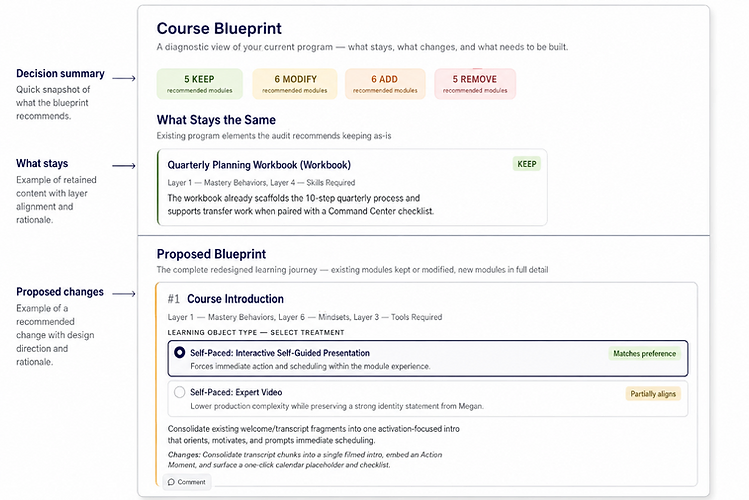
Example Course Blueprint used to align what stays, what changes, and what gets built before development begins.
Behavioral Architecture determines what the program must contain. Hook to Habit determines how learners move through the experience.
Seven layers that identify the behavior, capabilities, tools, conditions, and barriers the program must address.
Five phases that move learners from a reason to engage through action, capability, workplace application, and sustained performance.
Together, they prevent two common failures: a strong strategy that never becomes a coherent learner experience, and an engaging experience that is not built to produce the required behavior.

Founder and CEO
Erin is a learning strategist and the creator of Behavioral Architecture and Hook to Habit. She remains closely involved in strategy and instructional quality throughout Audacious Labs engagements.
Audacious Labs brings together senior strategy and specialists matched to the needs of each engagement, including learning design, writing, visual design, digital development, accessibility, quality assurance, and implementation.
Assess one current learning program across seven layers and receive an immediate high-level profile of its strengths and possible points of breakdown.
Illustrative example of a diagnostic result. Seven layers are shown with illustrative relative bars: Observable habits and behaviors, Habits to replace, Tools and environment, Skills required, Foundational knowledge, Beliefs and identity, and Failure points. Example strongest area: Foundational knowledge — well-developed conceptual prerequisites. Example potential risk: Tools and environment — missing environmental support makes the new behavior hard to perform. The bars are illustrative and not validated data.
Illustrative profile — not validated data.
Strongest layer
Foundational knowledge — well-developed conceptual prerequisites.
Example potential risk
Tools and environment — missing environmental support makes the new behavior hard to perform.
